Save on Utilities: Efficient Hot Water Systems for Homes

For many families, keeping monthly bills manageable is a top priority. One frequently overlooked area with significant savings potential is hot water.
Heating water accounts for a substantial portion of home energy costs, but by making a few key changes, you can achieve significant reductions in your utility bills.
If you are looking to install a new water heater in Hamilton or want to optimize your current system, understanding the factors that affect hot water efficiency is a valuable first step.
By embracing new technologies, adjusting daily habits, and taking advantage of available incentives, households can ensure their water-heating systems run efficiently.
This not only saves money but also contributes to a more sustainable home.
With advancements in modern heating solutions and improved insulation practices, it is easier than ever to cut back on unnecessary expenses without sacrificing comfort.
Additionally, reducing hot water consumption can extend the life of your appliances and help lower your household’s environmental footprint.
These strategies are accessible to most homeowners and renters alike, making energy savings achievable for any budget or lifestyle.
Recent regulations and rebate programs have been designed to encourage homeowners to adopt more efficient water-heating methods, making now a better time than ever to consider an upgrade.
Taking small steps now can lead to lasting benefits down the line, both financially and environmentally.
Understanding Water Heating Costs
The cost of heating water in a typical household accounts for roughly 18% of total energy use, making it the second-highest expense after heating and cooling.
The exact impact depends on water-use habits, the type of heater, and energy rates.
Even small inefficiencies, such as heat loss from uninsulated pipes or standby losses in older tank systems, can add up quickly over the course of a year.
Being aware of these factors is the first step to making targeted changes that will lower bills while maintaining comfort for everyone in your home.
According to the Natural Resources Defense Council, reducing hot water use can provide noticeable savings.
Upgrading to Energy-Efficient Water Heaters
Modern water heater technology has advanced significantly, with options like heat pump water heaters standing out for their remarkable efficiency.
These units can be up to seven times more efficient than older, conventional electric or gas tank heaters.
While high-efficiency models often come with a steeper upfront investment, the long-term payoff is considerable because you use far less energy to heat the same amount of water.
Many localities, including San Francisco, offer financial incentives, sometimes as much as $1,200 in bill credits, to make it easier for homeowners to opt for these energy-saving upgrades.
Investing in high-efficiency technology can shave hundreds off your annual energy costs, especially over the system’s lifetime.
For more details on incentives, see The Washington Post’s reporting.
Insulating Water Heater and Pipes
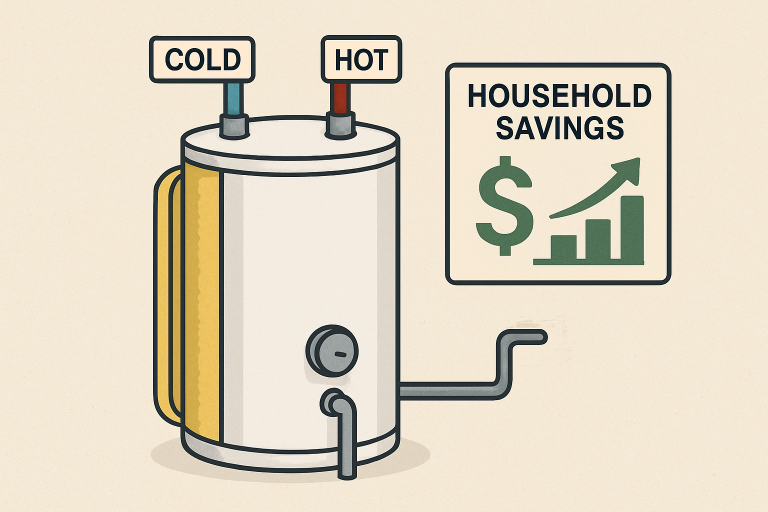
Insulating both the water heater itself and the hot water pipes is a straightforward solution that yields quick results.
Proper insulation prevents heat loss as hot water travels from the heater to your faucets or showerheads.
This means less energy is required to bring water up to temperature and to keep it warm while it sits in the tank.
Kits for insulating pipes and tank “jackets” are widely available and inexpensive, making this a high-impact, low-cost improvement that pays for itself in short order.
Installing Low-Flow Fixtures
Switching out standard showerheads and faucets for low-flow models is another efficient way to reduce both water and energy usage.
Low-flow fixtures can cut hot water consumption by 25% to 60%, thereby reducing the energy needed to heat that water in the first place.
These modern designs provide a comfortable showering or washing experience, while restricting flow enough to save hundreds, if not thousands, of gallons of water each year.
Households that switch to low-flow options typically see lower monthly bills almost immediately.
Fixing Leaks Promptly
Leaks might seem minor, but over time, even a slow drip can add up to substantial water waste and unnecessary heating costs.
For instance, a leak that drips once per second can waste over 1,600 gallons per year, enough to raise energy costs by $35 or more annually.
Performing regular maintenance checks and fixing leaky fixtures as soon as they are discovered is one of the simplest ways to keep both water and money from slipping away unnoticed.
This strategy also helps prevent water damage that could lead to costly repairs.
Adjusting Water Heater Temperature
Most water heaters are set too high. Experts recommend setting your water heater to 120°F (49°C) to balance comfort, safety, and efficiency.
This not only helps prevent accidental scalding, but also reduces the energy your system expends keeping water excessively hot.
Every 10-degree reduction can yield savings of 3% to 5% on water-heating costs.
This subtle change is a fast and effective method to make your system run more efficiently.
Utilizing Smart Thermostats
Smart thermostats have changed the way homeowners can control their energy use, including managing hot water schedules.
With learning algorithms and remote access via smartphone apps, these technologies can determine when your family most often uses hot water and adjust heating times accordingly.
This reduces standby losses and avoids heating water when it is not needed, translating into significant cost savings, especially in busy or variable households.
To see what smart home upgrades are available, check popular reviews on Consumer Reports.
Taking Advantage of Incentives and Rebates
The drive toward greener, more sustainable living has prompted government- and utility-run incentive programs to lower the financial barrier to efficient water-heating installations.
The U.S. Department of Energy, for example, has proposed standards that would require new electric storage water heaters to use heat pump technology.
The goal is to save consumers over $11 billion annually in combined energy and water bill reductions.
Many provinces, states, and cities also run similar programs for residents looking to upgrade.
Checking for relevant rebates before purchasing a new system can result in substantial upfront savings, making high-efficiency water heaters more affordable for everyone.
Integrating these efficient hot water solutions can be transformative for households aiming to cut costs while supporting environmental sustainability.
By taking steps such as proper insulation, installing low-flow fixtures, adopting smart thermostats, and upgrading to advanced water heaters, you not only lower your bills but also contribute to a smarter, greener home.
Are you ready to save on utilities?
— Matt
PIN FOR LATER:

I am a contractor and just a DIY guy in my spare time. I love building things and sharing my knowledge with other DIY’ers. You can do anything you set your mind to! When I am not building or fixing something, I am all about baseball. Go Tigers, go!